Drosera paradoxa
Drosera paradoxa
Sold out
Could not load pickup availability
Drosera paradoxa: The "firework" of carnivorous plants
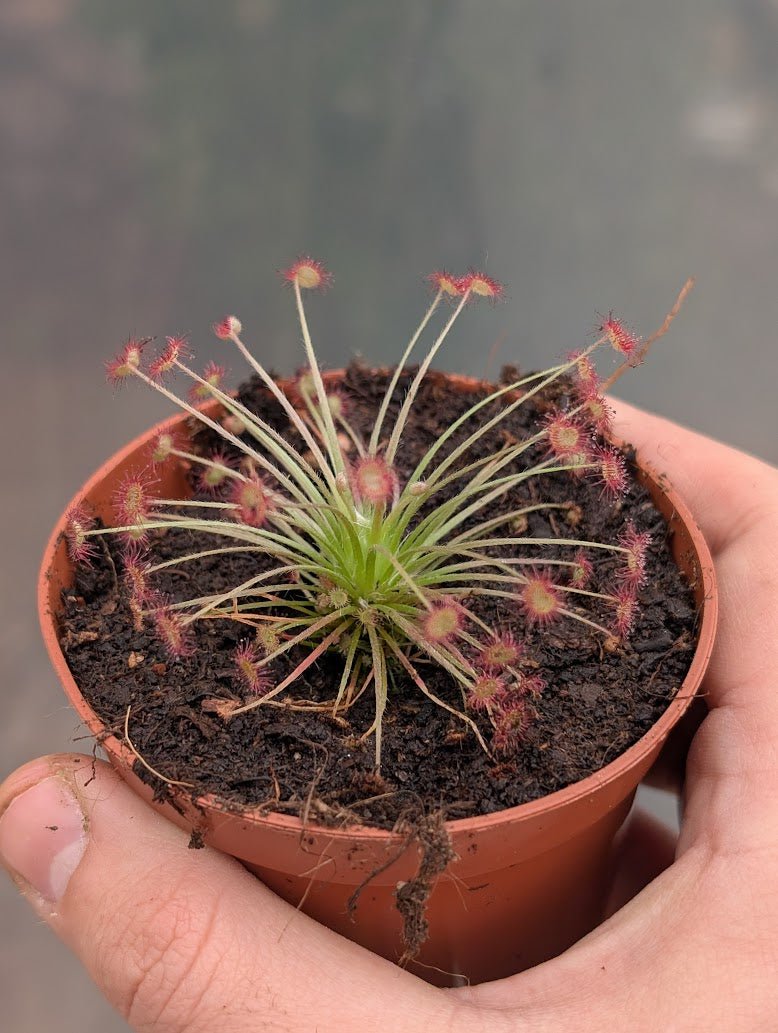
The Drosera paradoxa is a fascinating carnivorous plant belonging to the woolly Drosera complex of northern Australia. It stands out for its rosette-shaped structure with long, thin stems ending in small circular traps covered with glandular hairs. These hairs produce drops of "mucilage" (glue) that shine under the sun, attracting and trapping small insects.
At this medium size, the plant already shows its characteristic umbrella shape and its colors, which can range from bright green to deep red depending on the light intensity.
Essential care guide:
- Lighting: Requires plenty of light. Ideally direct sunlight (protecting it during extreme heat hours in summer) or strong LED lighting to maintain its red colors and glue production.
- Watering: Use only distilled, rain, or osmosis water. Always keep it with the "tray method" (a dish with 1-2 cm of water beneath the pot).
- Temperature: It is a tropical plant. Prefers warm temperatures (between 20°C and 35°C). It does not hibernate, so it must be protected from severe cold in winter.
- Substrate: Mix of blond peat and perlite (or quartz sand). Never use common soil or chemical fertilizers.
- Feeding: It catches small insects itself (fruit flies, flies). Do not force its traps with human food.
Shipping information:
- Shipped in a pot between 8.5 and 9 cm in diameter.
- As living beings, each plant is unique. A specimen with characteristics and health very similar to those in the picture will be sent.
* Tip: If you see it losing its glue drops, it is usually a sign of lack of light or low ambient humidity.
Plant and Pot Size Guide.
Plant and Pot Size Guide.
The sizes of the plants will always be those of the following item unless otherwise specified in the listing.
Dionaea muscipula
During the growing season, the size indicated on the website corresponds to the size of the rosette. That is, from tip to tip of the leaves. During winter, and due to the hibernation process, the size of the plants corresponds to what they will reach in the next growing season.
S: Young plant about 3cm in diameter. In a pot of 8.5-9cm
M: Semi-mature plant about 5cm in diameter. In a pot of 8.5-9cm
L: Adult plant about 8cm in diameter. In a pot of 8.5-9cm
XL: Adult plant about 11cm in diameter. In a pot of 8.5-9cm
Drosera
In winter, those from temperate climates that are in hibernation will be sent without leaves.
M: Several young / semi-mature plants in a pot 8.5-9cm in diameter.
L: Several adult plants capable of flowering in a pot 8.5-9cm in diameter.
Sarracenia
In Sarracenia, setting a standard size in centimeters is very complicated, since some plants grow upright and others grow sprawling, so the plant will be proportional in size to the pot. Obviously, we will not put a 20cm tall plant in a 5.5cm diameter pot nor a 5cm tall plant in a 14cm diameter pot.
S: Small size (Pot 5.5cm in diameter)
M: Medium size without flowering capacity (Pot 8.5cm in diameter)
L: Large size with flowering capacity (Pot 8.5cm in diameter)
XL: Very large size with more than one division and flowering capacity (Round pot 12cm in diameter or square 11x11cm)
Pinguicula
There are many species, some only 2-3cm as adults and others over 15cm, so a pot proportional to the size of the plant at the time of cultivation will be used, similar to the sarracenias.
S: Small-sized plants in a pot 5.5cm or 8.5cm in diameter.
M: Medium-sized plants in a pot 8.5cm in diameter.
L: Large-sized plants in a pot 8.5cm in diameter
Utricularia and Stylidium
Since these are mostly ground-covering plants, the size is determined by the portion of the pot surface colonized.
M: Plants in a pot 8.5cm in diameter occupying a medium portion of the pot.
L: Plants in a pot 8.5cm in diameter occupying the whole pot or nearly so.
Share